What Are the Top Types of Textile Finishing?
Textile finishing is the range of processes used to change a fabric’s appearance, feel, or performance after it has been made. A finish can make cotton feel softer, give a surface a slight sheen, or help a textile resist water. Some treatments are mechanical, using pressure, heat, or abrasion. Others apply chemicals to the fibers or fabric. Small changes matter.
Brushing raises fine fibers to create a soft, fuzzy surface. Calendaring presses fabric between rollers, often producing a smoother finish. Sanforizing helps reduce shrinkage during washing. Chemical finishes may add softness, wrinkle resistance, or water repellency, but their effects vary. A water-repellent finish, for example, does not necessarily make a fabric waterproof. The result depends on the fiber, fabric construction, treatment, and care conditions.
Choosing a finish means balancing the intended use with comfort, durability, appearance, and maintenance. A crisp finish may suit a tablecloth, while a softer hand may work better for clothing. Supplier specifications and relevant test results can help clarify what a finish actually does. Still, performance claims deserve careful reading; names alone do not tell the whole story. This guide explores the top types of textile finishing, how they work, and where they are commonly used. It also considers practical limits, since a treatment that improves one quality may affect another. The best option depends on the fabric and the job. That trade-off matters.
Mechanical Finishing for Surface and Texture Modification
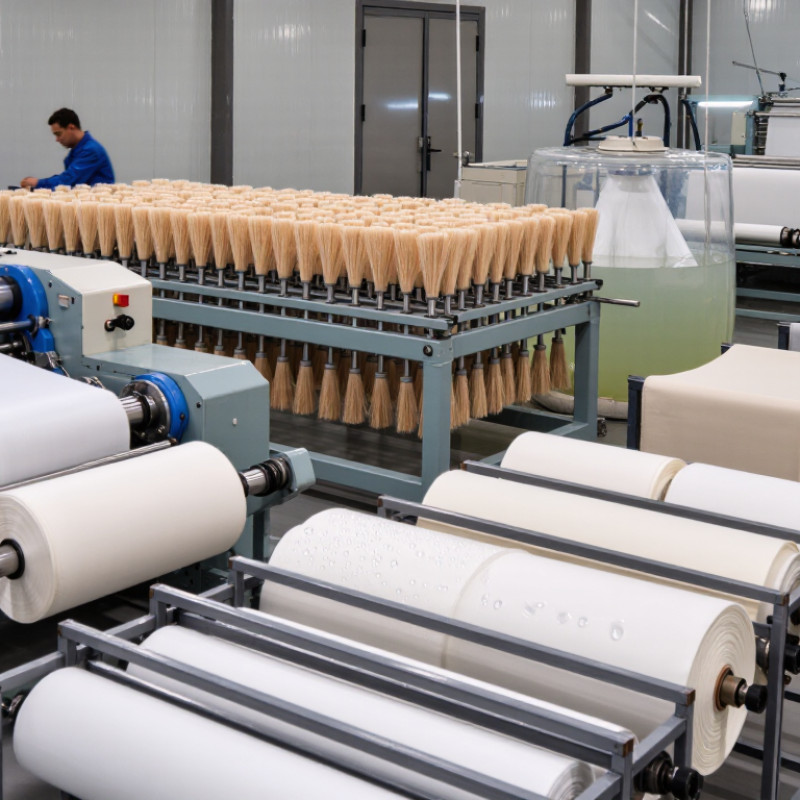
Mechanical finishing changes a fabric’s surface and feel through physical action rather than added chemistry. Raising lifts fine fibers into a soft nap; shearing trims that nap; calendering presses cloth between rollers to create a smoother, sometimes shinier face. Pressure, roller speed, moisture, and heat all matter. Small shifts matter. A brushed cotton can feel plush, while excess pressure may flatten its loft or leave uneven bands.
Textile Exchange’s Materials Market Report 2024 estimates global fiber production reached 124 million tonnes in 2023, with production projected to rise to 160 million tonnes by 2030. That scale makes consistent finishing important, but volume alone does not define quality. A finish must suit the fabric’s intended use: a raised surface may add warmth, while a compact, smooth face may be better for crisp shirting. There is no universal setting. Fabric lots vary, and a quick visual check can miss changes in hand or thickness.
Tips: Test a small swatch first. Record roller pressure, speed, and temperature, then inspect the fabric under consistent light and feel. If the surface looks right but feels board-like, reconsider the pressure. That small mismatch is easy to overlook.
Chemical Finishing for Improved Fabric Properties
Chemical finishing changes how a fabric performs after weaving or knitting.
A softener can reduce the dry, papery feel of cotton; a water-repellent treatment can make droplets bead on a jacket sleeve. Wrinkle-resistant and flame-retardant finishes solve different needs, but each adds chemicals and process steps. The right choice depends on the end use, fiber type, and how often the garment will be washed.
There is no universal finish.
The scale matters. Textile Exchange’s 2024 Materials Market Report estimates global fiber production reached 124 million tonnes in 2023. That figure covers fibers, not finishing chemicals, so it should not be mistaken for a measure of finish-related impact. UNEP’s 2023 textile value-chain roadmap places the sector’s greenhouse-gas emissions at roughly 2–8% of the global total.
Finishing is only one part of that footprint, yet heat, water, and treatment chemistry still deserve scrutiny. Test samples for properties such as spray resistance, abrasion, and wash durability, using recognized methods such as AATCC or ISO tests. Then check performance again after laundering.
The trade-off is not always neat.
A finish that works beautifully at first may fade quickly, while a longer-lasting treatment may require a careful review of its chemistry and disposal pathway.
Thermal Finishing for Shape and Dimensional Stability
Thermal finishing helps fabric hold its intended shape after cutting, sewing, and washing. In heat setting, controlled heat and tension stabilize thermoplastic fibers such as polyester and nylon. The process can reduce later shrinkage and skew, but it cannot correct every construction problem. A loosely knitted fabric may still stretch during handling. Small changes matter.
Tips: Check the fiber blend before setting temperature and dwell time. Keep fabric width and tension consistent through the machine. Test shrinkage and skew after conditioning or laundering, not only at the finishing line. Measure again.
A reliable setting recipe depends on fiber content, fabric weight, moisture, and equipment. Excessive heat can cause yellowing, a harsh hand, or unwanted shine, especially on sensitive blends. Record the line conditions alongside test results so adjustments can be traced. One detail is easy to miss: a stable width may come at the cost of softness. There is no perfect setting for every fabric, and a small trial may reveal that the first recipe was too aggressive. Combine dimensional checks with touch and appearance assessments before approving production.
What Are the Top Types of Textile Finishing? - Thermal Finishing for Shape and Dimensional Stability
| Thermal finishing method |
Typical materials |
Representative conditions |
How it supports shape or dimensional stability |
Key considerations |
| Heat setting under controlled tension |
Thermoplastic fibers and blends, especially polyester and nylon fabrics |
Often carried out on a stenter; polyester fabrics commonly use roughly 170–200 °C for tens of seconds. The correct setting depends on fiber, fabric construction, and equipment. |
Heat allows thermoplastic fibers to relax or be set in a controlled width and length. Cooling helps retain the chosen dimensions and reduces later shrinkage or distortion. |
Excessive heat or dwell time can cause yellowing, strength loss, or damage to elastane and sensitive blends. Validate settings on the actual fabric. |
| Relaxation heat drying |
Knitted fabrics and other constructions prone to tension-related shrinkage |
Fabric is dried with low mechanical tension, often in a tumble or relaxed-width dryer. Temperature and residence time are selected for the fiber and moisture level. |
Allows residual stresses from knitting, wet processing, or stretching to relax before the fabric is finished or made into garments. |
Can reduce residual shrinkage, but does not permanently heat-set non-thermoplastic fibers. Fabric handling and drying uniformity affect results. |
| Thermal curing of easy-care finishes |
Cellulosic fabrics such as cotton, and some cotton blends treated with crease-resistant finishing agents |
A representative curing range is about 150–180 °C for approximately 1–3 minutes; the recipe and process equipment determine the actual conditions. |
Heat cures the applied finish, helping improve crease recovery and retain garment shape during use and laundering. |
This relies on a chemical finish rather than thermoplastic heat setting. Cure conditions can affect tensile strength, tear strength, handle, and shade. |
| Heat setting of synthetic blends |
Blends such as polyester-cotton or nylon-elastane, where the synthetic component is heat-settable |
Conditions are chosen to set the thermoplastic component while staying within the heat tolerance of the other fibers, dyes, and finishes. |
Stabilizes the synthetic component and can help control fabric width, skew, and dimensional change in the finished blend. |
The blend’s most heat-sensitive component often limits the process window. Test shrinkage, appearance, and stretch recovery after finishing. |
|
Operating temperatures and times are representative ranges, not universal specifications. Final settings should be established through trials for the specific fiber blend, fabric construction, finish, and machinery.
|
Functional Finishing for Specialized Performance
What Are the Top Types of Textile Finishing?
Functional Finishing for Specialized Performance
Functional finishing adapts fabric to demanding uses. A moisture-wicking treatment can help move sweat away from skin during exercise. Water-repellent finishes help droplets bead on outdoor clothing, while flame-retardant treatments can reduce ignition risks in specific applications. Antimicrobial finishes may limit odor-causing microbial growth, but they are not a substitute for washing or hygiene. The right choice depends on the fiber, garment design, and conditions of use.
Performance has trade-offs. A heavy coating may change a fabric’s drape, breathability, or softness. Some effects also weaken after repeated washing, so laundering instructions and test results matter. For example, a treated work shirt should be assessed after wash cycles, not just straight from the factory. There is no perfect finish. Even useful treatments can disappoint when they do not match the wearer’s needs.
Tips: Define the main performance goal before choosing a finish. Ask how the fabric performs after laundering, and check whether testing reflects real use. Feel a sample, too; numbers alone can miss an uncomfortable stiffness.
What Are the Top Types of Textile Finishing?
Functional Finishing for Specialized Performance
Functional finishes are designed to add specific properties, such as water repellency, antimicrobial activity, UV protection, flame resistance, wrinkle resistance, or moisture management. Scores show illustrative emphasis on each finish’s primary function—not measured performance; actual results depend on the fabric, treatment, and test method.
Enzymatic Finishing for Controlled Fabric Refinement
Enzymatic finishing refines fabric through targeted biological action. Cellulases can remove tiny surface fibers from cotton, helping reduce fuzz and create a smoother hand. Pectinases may support preparation of plant-based fibers, while proteases are used on protein fibers such as wool. The right enzyme depends on the material and desired result. It is controlled work, not a shortcut.
Temperature, pH, treatment time, and enzyme concentration all affect performance. In a finishing room, a small change in dwell time can alter softness or surface appearance. Excessive treatment may weaken fibers or change the fabric’s look, so trial samples matter. Results can also vary across fabric constructions. That part is easy to underestimate.
Tips: Test a swatch before treating a full batch. Check strength, shade, hand feel, and pilling after processing. Keep water conditions and machine loading consistent; otherwise, comparisons become unreliable. Record settings, even when a trial seems ordinary.
Enzymatic finishing can offer a more selective alternative to broad mechanical abrasion, but it still needs careful monitoring. Enzymes eventually lose activity, and residues should be removed according to the process specification. A smooth sample is encouraging, yet it does not prove the whole roll will behave identically. Recheck production fabric under the same inspection conditions.