
Blog
- Home
- /
- Blog
What Are the 10 Best Textile Auxiliary Chemicals for Buyers?
Choosing textile auxiliary chemicals is a practical buying decision, not a search for the longest product list. A softener that feels smooth on a sample may affect absorbency, shade, or later finishing. A wetting agent that performs well in one recipe may behave differently with another fiber, water supply, or machine. Small details matter: a trial swatch, a clear technical data sheet, and a repeatable dosing method can reveal more than a polished sales claim.
Textile coloration researcher Dr. S. M. Burkinshaw has studied how dyes, fibers, and processing conditions interact. A useful takeaway from that work is that chemical performance depends on the whole process, not the product name alone. This is a paraphrase, not a verified direct quotation. Buyers should compare auxiliaries by function, substrate compatibility, operating conditions, documentation, and results from controlled trials. A low unit price can be misleading if the product increases rework or creates inconsistent batches.
The guide examines ten common categories, including wetting agents, detergents, sequestering agents, leveling agents, and softeners. It also considers what buyers should ask suppliers before ordering: recommended dosage, storage conditions, compatibility, and evidence supporting performance claims. Not every mill needs every product. That is worth remembering. Selection should reflect the fabric, process, quality target, and available test data. A careful shortlist is often more useful than a crowded catalogue.
Understanding Textile Auxiliary Chemicals and Their Role
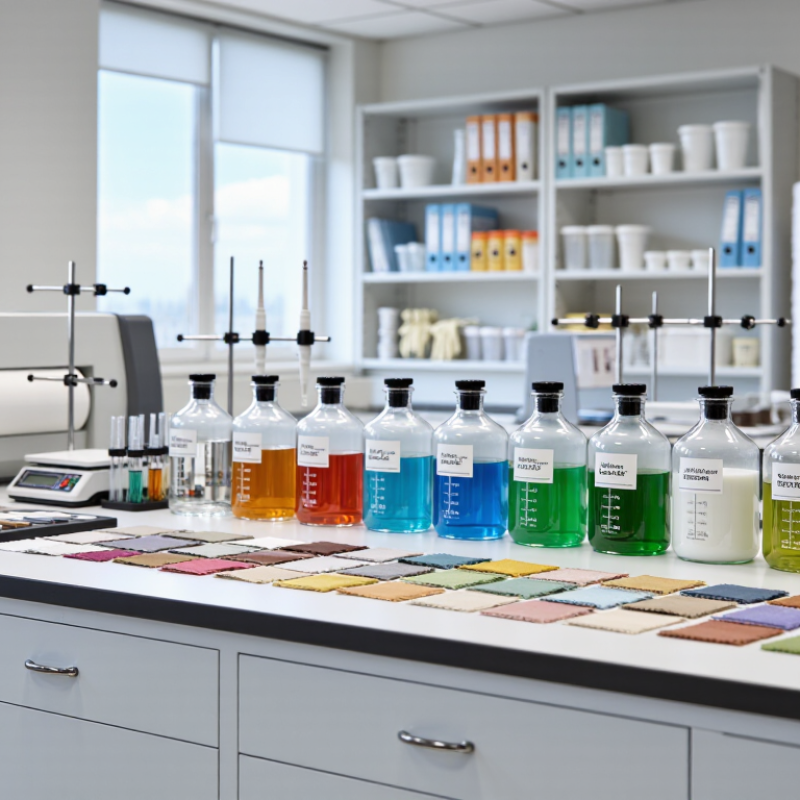
Textile auxiliary chemicals are processing aids used before, during, or after dyeing and finishing. They are not usually the color itself. Instead, they help water wet fibers, control foam, remove size, manage dye movement, or adjust fabric handfeel. A desizing enzyme can clear starch from cotton; a sequestrant can bind hardness ions that interfere with dyeing. Small doses matter.
Their role depends on the fiber and the process. A mill may adjust pH, temperature, and chemical concentration to suit cotton, polyester, or a blended fabric. In practice, a dye bath can look uniform while a finished fabric shows uneven shade. Testing on a small swatch helps reveal such problems, though it cannot represent every production condition.
The scale is substantial. Textile Exchange’s Materials Market Report 2024 estimates that global fiber production reached 124 million tonnes in 2023, up from 116 million tonnes in 2022. This is not a measure of auxiliary-chemical use, but it shows the size of the material flow these processes serve. Buyers should examine technical data sheets and safety data sheets, then check compatibility, dosage, and wastewater implications. There is no universal “best” auxiliary; performance depends on the fabric, water quality, equipment, and finish required.
What Are the 10 Best Textile Auxiliary Chemicals for Buyers?
Typical indicative application dosage ranges (% on weight of fabric, or % owf)
Auxiliary chemicals support processes such as wetting, cleaning, bleaching, dyeing, and finishing. The ranges shown are general starting points, not fixed recipes; actual dosage depends on the fiber, formulation, equipment, and process conditions. Follow supplier guidance and run trials before production.
How Buyers Can Assess Chemical Performance and Compatibility
A textile auxiliary can perform well alone and fail in a real dye bath. Buyers should assess it on the intended fiber, recipe, water quality, and machine conditions. Textile Exchange’s Materials Market Report 2024 estimates global fiber production reached 124 million tonnes in 2023. At this scale, small dosing or compatibility problems can affect large production runs. The UNEP report Sustainability and Circularity in the Textile Value Chain places fashion’s share of global greenhouse gas emissions at 2–8%, reinforcing the value of reducing reprocessing and waste.
Run a controlled lab trial before production. Record dosage, bath pH, temperature, water hardness, and addition order; change one factor at a time. Check wetting time, foam, shade uniformity, fabric handle, and residue on a rinsed swatch. Small trials matter. For dyed goods, AATCC TM61 evaluates colorfastness to accelerated laundering, while AATCC TM8 assesses crocking. These tests help compare results, but they cannot fully reproduce every mill’s equipment or water.
Compatibility deserves equal scrutiny. An enzyme may lose activity outside its preferred pH range, while a cationic softener can destabilize some anionic formulations. Test mixtures in a clear beaker first, then on fabric; watch for haze, settling, or unexpected foam. Review safety data and chemical declarations, and check restricted-substance requirements such as the ZDHC Manufacturing Restricted Substances List. Supplier data is useful, but it is not a substitute for trials using the buyer’s actual recipe. A missed variable can still distort the result.
Ten Essential Textile Auxiliary Chemicals by Function
Textile Exchange’s Materials Market Report 2024 puts global fibre production at 124 million tonnes in 2023. That scale makes auxiliary selection a process-control decision, not a purchasing footnote. Wetting agents help liquor spread across dry cotton; scouring detergents remove waxes and oils. Chelating agents bind hardness ions, while enzymes target starch size or surface fuzz. Peroxide stabilizers help control bleaching. Small doses matter.
During dyeing, leveling agents slow uneven uptake, and dispersants keep particles suspended. Fixing agents improve dye retention after rinsing; softeners change hand feel, from crisp shirting to a softer knit. Defoamers control foam in jet machines and padding baths. UNEP’s 2023 textile-value-chain stocktaking estimates that textiles contribute 2–8% of global greenhouse-gas emissions. Reduced rework and efficient rinsing may help, but auxiliaries alone cannot guarantee lower impact. Buyers should check the substrate, bath pH, temperature, dosage, and wastewater compatibility in production trials. Not always. A technically elegant recipe may fail with a different water supply. Record the actual result.
Matching Auxiliary Chemicals to Textile Processing Stages
Textile auxiliaries work best when chosen for a specific process stage, not just by price. During preparation, wetting agents help water spread across dry yarn or fabric. Desizing enzymes target starch-based size, while scouring agents remove oils and waxes. Chelating agents bind troublesome metal ions in hard water. For peroxide bleaching, stabilizers help control the reaction. Small changes matter.
Dyeing brings different needs. Leveling agents support more even shade development, dispersants help keep particles suspended, and pH buffers maintain a suitable bath condition. After dyeing, fixing agents can improve resistance to washing, while softeners adjust the fabric’s hand. Defoamers may be useful where foam disrupts circulation or leaves marks. That is ten useful categories, but no list fits every mill. Fiber type, machine design, water quality, and recipe all affect performance. A softener that feels pleasant on one fabric may reduce absorbency on another. Test small batches, record dosage and temperature, and check the finished fabric after washing. The match is not always obvious.
Evaluating Safety, Sustainability, and Supplier Quality
For buyers comparing wetting agents, enzymes, peroxide stabilizers, chelating agents, and softeners, “best” starts with process fit. A low-foam wetting agent may suit a jet dyeing line, while another can leave uneven patches. Run a small trial using the actual fiber, recipe, water, and machine. Details matter. A product sheet alone cannot predict shade, fabric handle, or rinse performance.
Review current safety data sheets, hazard classifications, recommended protective equipment, storage limits, and spill guidance before purchase. Ask suppliers for biodegradability or wastewater data where relevant, rather than relying on broad environmental claims. Check dosage, bath stability, rinse demand, and effects on effluent treatment. A concentrated product can reduce packaging, but overdosing may erase that benefit. There is no perfect score. I still find sustainability comparisons difficult when suppliers use different test methods or omit testing conditions.
Supplier quality shows in consistency and evidence. Request specifications, batch certificates, shelf-life details, change-control procedures, and realistic technical support response times. Compare several production lots, retain a sealed sample, and record trial results. Ask how complaints are investigated and whether changes to raw materials trigger buyer notification. Smaller mills may lack laboratory capacity, so supplier guidance can help, but it should not replace verification. Even reliable suppliers can miss a detail.
What Are the 10 Best Textile Auxiliary Chemicals for Buyers? — Evaluating Safety, Sustainability, and Supplier Quality
“Best” depends on the fiber, process, equipment, and destination-market requirements. Use this comparison as a purchasing checklist; confirm suitability with process trials and current technical and safety documentation.
| No. | Chemical category | Typical role | Safety considerations | Sustainability considerations | Supplier quality checks |
|---|---|---|---|---|---|
| 1 | Enzymes | Used in processes such as desizing, biopolishing, and denim finishing; enzyme type determines the textile target and process conditions. | Enzyme dust or aerosols can cause respiratory sensitization. Prefer controlled liquid or low-dust forms, use suitable protective measures, and follow the safety data sheet (SDS). | Enzymatic processing can operate under milder conditions in some applications, but actual water, energy, and chemical savings depend on the recipe and process controls. | Check enzyme activity and batch consistency, recommended pH and temperature range, storage stability, and application-specific trial results. |
| 2 | Wetting agents | Help water and treatment liquors spread over or penetrate textile substrates more evenly. | Hazards vary by surfactant chemistry and concentration. Review the SDS for eye, skin, inhalation, and aquatic hazards; avoid mist generation where relevant. | Request data on biodegradability, aquatic toxicity, and restricted surfactants. Assess the full formulation rather than relying on “eco” wording alone. | Verify wetting performance, foam profile, compatibility with the process, and consistency between batches. |
| 3 | Scouring agents | Remove oils, waxes, and other impurities from fibers or fabric before dyeing or finishing. | Alkaline or concentrated products may irritate or burn skin and eyes. Check the SDS, pH, handling instructions, and compatibility with process equipment. | Compare performance at the intended dosage and temperature, and assess rinse-water demand, wastewater load, and ingredient biodegradability. | Ask for composition disclosure appropriate to your program, recommended process window, and results from tests on the relevant fiber and construction. |
| 4 | Chelating and sequestering agents | Bind metal ions in process water or textile baths to help reduce deposits and improve process consistency. | Risk depends on the specific ingredient and formulation. Consult the SDS and check whether the product is compatible with the plant’s wastewater treatment system. | Review persistence, biodegradability, and metal-mobilization potential. Consider alternatives only after confirming that they work in the actual water conditions. | Request performance data for relevant water hardness and metal-ion levels, plus guidance on dosage and wastewater handling. |
| 5 | Hydrogen peroxide stabilizers | Help control peroxide decomposition during oxidative bleaching, supporting more consistent bleaching conditions. | Peroxide and alkaline bleaching baths can be corrosive and reactive. Follow the SDS and site procedures for chemical segregation, personal protection, and spill response. | Evaluate the complete bleaching recipe, including peroxide efficiency, rinse requirements, and effluent impact; the auxiliary alone does not determine environmental performance. | Check compatibility with the bleaching system, performance across the intended temperature and pH range, and clear dosing guidance. |
| 6 | Dye dispersing agents | Help keep disperse dyes distributed in the bath and reduce aggregation during dyeing of suitable synthetic fibers. | Review the SDS for dust, inhalation, and aquatic-hazard information, particularly for powdered products and concentrated solutions. | Request information on biodegradability and wastewater treatability. Assess the overall dyeing effluent, not just the auxiliary ingredient. | Evaluate dispersion stability, compatibility with the selected dyes and process, foam behavior, and reproducibility in production trials. |
| 7 | Dye leveling agents | Help promote more uniform dye uptake by influencing dye migration or exhaustion, depending on the fiber and dye system. | Hazards vary with the formulation. Review the SDS and check compatibility with other bath chemicals to avoid unexpected process or handling issues. | Assess whether the product enables reliable shade control with minimal reprocessing, and request information about wastewater behavior and ingredient restrictions. | Require shade and levelness trials on the intended substrate, along with dosage recommendations and batch-to-batch performance data. |
| 8 | Textile softeners | Modify fabric hand and surface feel; common chemistries include cationic, nonionic, and silicone-based formulations. | Check the SDS for irritation and handling hazards. Confirm that the product is compatible with the fabric, subsequent finishing steps, and any applicable product restrictions. | Compare durability, required dosage, wastewater profile, and effects on fabric properties such as absorbency or recyclability. | Request test data for hand, yellowing, absorbency, wash durability, and compatibility with the intended application. |
| 9 | Water-repellent finishes | Provide water repellency to selected textile applications; available chemistries differ in performance and environmental profile. | Review the SDS and application controls, including ventilation and exposure precautions. Confirm chemical compliance for the intended market and end use. | Ask for a clear statement of fluorinated chemistry status and supporting documentation where relevant. Compare performance and durability rather than relying on broad “PFAS-free” or “green” claims alone. | Check repellency test results, durability after care cycles, substrate compatibility, and documentation for restricted-substance requirements. |
| 10 | Formaldehyde-free crosslinkers | Used in selected durable-press or easy-care finishing systems to improve wrinkle recovery or dimensional performance. | “Formaldehyde-free” does not mean hazard-free. Review the SDS for reactive ingredients, handling precautions, and any conditions that may affect worker exposure. | Assess curing temperature and energy demand, durability, emissions, and the full formulation’s environmental profile. | Request finished-fabric test results, curing guidance, storage stability, and relevant formaldehyde test data for the intended product requirements. |
Buyer checklist: obtain a current SDS and technical data sheet, confirm local regulatory and restricted-substance requirements, review available composition and environmental data, and run a controlled production trial before approval. Safety and environmental properties vary by formulation and use conditions.
Related Posts
-
China Top Textile Chemical Processing Manufacturers?
-

7 Tips for Choosing Textile Processing Chemicals
-

How to Choose the Best Textile Industry Chemicals in 2026?
-
What Are Textile Auxiliary Chemicals and How Do They Work?
-
Top Textile Chemicals and Auxiliaries Suppliers Worldwide?
-

Top Textile Finishing Chemicals Suppliers 2026?