2026 Top Bulk Matcha Powder Suppliers for Global Buyers
In 2026, global buyers are treating Bulk Matcha Powder as a serious ingredient, not a novelty. Cafés, beverage brands, bakeries, and supplement manufacturers need stable supply and clear documentation. Japan remains central to premium matcha production, while other origins may offer different price points and flavor profiles.
Sen no Rikyu, the influential Japanese tea master, wrote, “Tea is naught but this: you boil the water, then you make the tea and drink it.” His simple principle still matters. The final cup depends on countless practical details. Cultivar, harvest season, shading period, steaming, drying, and milling all affect color and taste. Bright jade color helps, but it does not prove quality.
This guide reviews leading Bulk Matcha Powder suppliers for international purchasing teams. It considers origin transparency, organic certifications, pesticide-residue testing, certificates of analysis, particle size, moisture control, packaging, minimum order quantities, and export experience. Supplier communication also matters. Slow replies can become expensive delays.
Not every “ceremonial” label deserves trust. Some buyers focus too heavily on appearance and overlook bitterness, oxidation, or weak traceability. That is an understandable mistake. A responsible comparison should include samples, production dates, batch records, and independent verification where appropriate. Buyers must also confirm destination-country food rules, labeling requirements, and import documents. No supplier is perfect. The strongest partners are usually the ones that disclose limitations clearly and improve their systems over time.
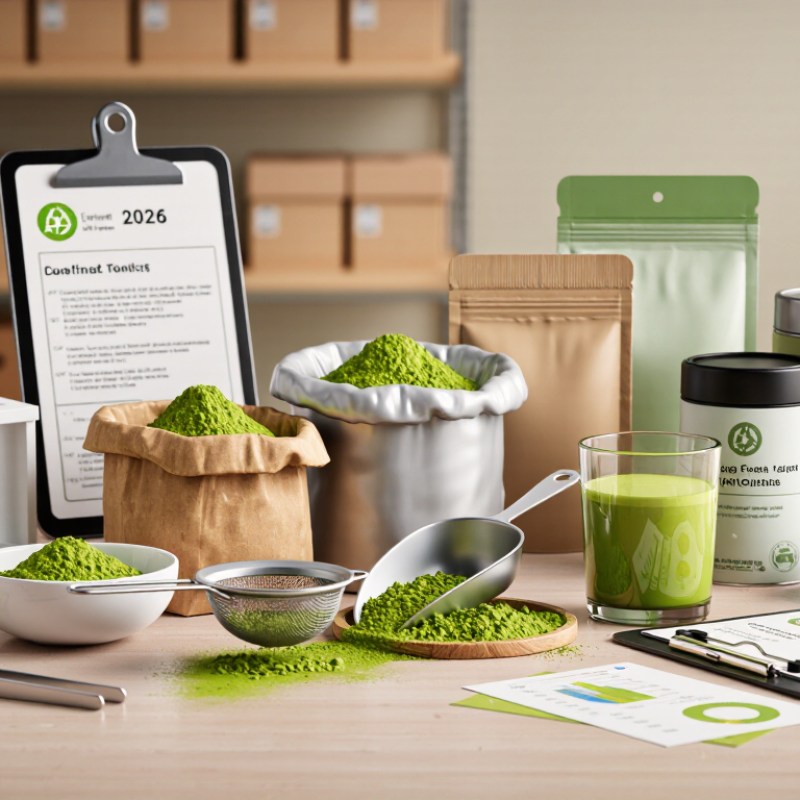
Matcha Grades and Bulk-Supply Terms: Tencha, Ceremonial, and Culinary
2026 Top Bulk Matcha Powder Suppliers for Global Buyers
Matcha Grades and Bulk-Supply Terms: Tencha, Ceremonial, and Culinary
For global buyers, matcha grade begins with tencha, not packaging language. Tencha is shade-grown tea leaf, steamed, dried flat, and stripped of stems before milling. USDA FAS Japan Tea Annual 2024 places Japan’s annual tea output near 80,000 metric tons, but only a fraction becomes matcha. That scarcity affects lead times and prices. Shade matters. Serious suppliers should state harvest year, prefecture, cultivar, milling method, and lot traceability. A green color alone proves little; oxidation, aroma, and particle distribution also require testing.
“Ceremonial” has no single international legal definition. Buyers should request sensory specifications instead: vivid green liquor, clean umami, low bitterness, and a smooth finish. Culinary matcha can be more robust and slightly more bitter. It suits bakery, dairy, beverages, and premixes. Grand View Research estimated the global matcha market at roughly USD 2 billion in 2023, with growth nearing 10% annually through 2030. Such expansion invites loose grading. I would not approve samples by appearance alone.
Bulk terms need equal attention. Purchase orders should define MOQ, annual volume, tolerance, delivery window, Incoterm, packaging barrier, and storage temperature. Request a current certificate of analysis covering moisture, microbiology, heavy metals, and pesticide residues. For sensitive buyers, retain a sealed reference sample from every lot. Particle size affects suspension and filling performance. Ask for evidence. COAs should match the shipped lot, not a generic factory template. Even experienced teams can miss seasonal flavor shifts; contracts should allow documented rejection when specifications fail.
Global Matcha Demand: Market Size and CAGR Forecasts from Industry Reports
Global matcha demand is entering a more measured growth phase. Published industry reports often estimate the market at roughly US$2–4 billion in the mid-2020s. Forecasts commonly project a compound annual growth rate of about 7%–10% through the early 2030s. The range is wide.
Different reports use different definitions. Some count only ceremonial and culinary powder, while others include ready-to-drink beverages, supplements, and food-service blends. This makes direct comparisons difficult. A buyer should check the base year, regional coverage, and currency assumptions before trusting a headline figure.
Demand is strongest where wellness drinks, café menus, and premium home preparation overlap. North America and Europe continue expanding, while East Asian markets provide deeper cultural and production context. Yet growth is not perfectly smooth. Harvest conditions, shade-growing capacity, labor costs, and exchange rates can change supply within one season.
For global buyers, CAGR alone is not enough. A forecast may show strong demand, but it cannot guarantee stable quality or shipment availability. Practical checks include pesticide documentation, microbiological testing, batch traceability, moisture control, and packaging that limits light and oxygen exposure. A bright green color helps, but it is not proof of superior grade.
Bulk purchasing also requires attention to particle size, bitterness, aroma, and intended use. A beverage manufacturer may value dispersibility, while a premium retail pack needs a cleaner finish. Forecasts guide planning. They do not replace sampling. Personally, I would treat every aggressive growth estimate as useful, but incomplete.
Japan’s Tencha Production and Export Data: Supply Trends for 2026 Buyers
Japan’s tencha supply is becoming more important for global matcha buyers in 2026. Tencha is shade-grown, steamed, dried, and processed before stone milling. Its production remains concentrated in major tea regions, including Kyoto, Kagoshima, Aichi, and parts of Shizuoka. Regional weather can still change the balance.
Recent Japanese agricultural and trade statistics indicate steady interest in powdered green tea and processed tea exports. However, official export categories may combine matcha with other powdered teas. Tencha production data can also appear separately from finished matcha shipments. This makes direct comparison difficult. Buyers should avoid treating one export figure as the complete market picture. The data is useful, but imperfect.
For procurement planning, the 2026 harvest calendar matters. Spring harvests usually receive strong attention because freshness, color, and aroma are closely monitored. A reliable supplier should provide the production region, harvest period, milling date, lot number, and storage conditions.
Buyers should also request laboratory documents covering contaminants, pesticide residues, moisture, and microbiological safety. Small sample checks are practical. A bright green powder alone proves little.
Some buyers may overlook flavor stability during shipping, especially under heat and humidity. That mistake can weaken an otherwise careful sourcing plan. Japanese supply remains technically strong, yet prices and availability may shift with weather, labor, energy costs, and domestic demand. Clear specifications and repeat testing remain essential for bulk purchasing.
Top Bulk Matcha Suppliers Ranked by Capacity, Certifications, and MOQ
For 2026 sourcing, bulk matcha suppliers should be ranked by verified capacity, certifications, and minimum order quantity (MOQ). Grand View Research projects the global matcha market to expand strongly through 2030, with demand rising across beverages, bakery, and nutrition products. That growth makes supply consistency more important than attractive quotations.
Capacity claims require evidence. Buyers should request annual milling volume, monthly export records, lot numbers, and recent production audits. A practical ranking places suppliers with stable multi-ton output above smaller processors. Yet capacity alone is not enough. Certifications such as ISO 22000, HACCP, FSSC 22000, and organic approval can indicate stronger process control. Certification scope matters. Some documents cover packing only, not cultivation or milling.
MOQ separates suitable suppliers from unsuitable ones. Large industrial processors may require 500 kilograms or more per order, while flexible exporters may accept 25–100 kilograms for initial testing. Buyers should compare MOQ with lead time, harvest season, storage conditions, and delivery performance. The International Trade Centre’s trade data shows continued global tea export activity, but HS codes rarely isolate matcha precisely. This limitation deserves attention. A polished ranking can still hide weak product-level evidence. Ask for pesticide screening, heavy-metal results, microbiological reports, and color specifications before signing a long-term contract. Freshness matters. Tin packaging, oxygen control, and refrigerated storage can protect the vivid green powder during transit.
2026 Top Bulk Matcha Powder Suppliers for Global Buyers
Anonymous supplier tiers ranked by annual processing capacity, certification coverage, and minimum order quantity.
The chart uses non-company-specific procurement benchmark bands commonly applied in global bulk matcha sourcing. Capacity is shown in metric tons per year, certification coverage counts major food-safety and organic schemes, and MOQ is shown in kilograms.
Buyer Checklist: COA Testing, Heavy Metals, Pesticides, Pricing, and Logistics
Global buyers should treat matcha sourcing as a documented risk review, not a simple price comparison. The 2024 USDA Foreign Agricultural Service Japan Tea Annual estimated Japan’s 2023 tea output at roughly 78,000 metric tons. That scale does not guarantee uniform matcha quality. Ask for a batch-specific COA, sampling date, laboratory name, test methods, and matching lot number. Check microbiology, moisture, ash, color specifications, and sensory results where relevant. A generic PDF is weak evidence. I would request retained samples before approving a full container.
Risk Review Heavy metals require separate attention. Test lead, cadmium, arsenic, and mercury through ICP-MS or an equivalent validated method. Pesticide screening should include broad multi-residue methods, such as LC-MS/MS and GC-MS/MS. EFSA’s 2023 monitoring report covered 132,793 food samples, with about 98% compliant with legal limits. The report is broad, not matcha-specific. Tea leaves are consumed whole, so destination-market limits matter greatly. Ask laboratories to report detection limits, not only “pass” or “fail.” This detail is often overlooked.
Compare delivered cost per kilogram, not just the supplier’s ex-works quote. Include testing, packaging, insurance, duties, and freight volatility. A low price may conceal short shelf life or incomplete documentation. Require light- and oxygen-barrier packaging, lot traceability, production dates, and humidity controls. Confirm MOQ, Incoterm, lead time, pallet dimensions, and customs documents. My checklist is still imperfect; freight delays and seasonal color changes can defeat careful forecasts. Build a small contingency.